Total Pageviews


Saturday, May 19, 2012

Day #5 - May 18th, 2012

Day #5: May 18th, 2012


Click here to view a web album with 72 high-resolution photos from this day.

I am writing this blog at 10PM on 5/18. We have been unable to access the Internet since arriving in Zapata Peninsula, so I fear there will be a 3 day gap between blog entries. Please forgive me for that!

This is our last day on the Zapata Peninsula. This was perhaps the mellowest day in terms of the number of different activities.

As usual, we left on our 9AM bus with Eduardo and Ludwig. We picked up a local guide who brought us into the Zapata National Park for a nature walk and bird viewing trip. The land ranged from fairly open dry tropical forest dominated by tall palm trees to dense jungle dominated by shrubs:

Along the way, we spotted a wide variety of wildlife, including several interesting birds such as the Cuban screech owl, Cuban pygmy owl (photo #1 below), tocororo (the national bird of Cuba, photo #2), the West Indian striped woodpecker, and the Cuban oriole. We also spotted termites, crabs (found here because the area floods during the rainy season, photo #3), and a large snake that was tamed by our intrepid visiting professor and nature expert Hinrich (photo #4):

The walk lasted about 3 hours and would have been entirely pleasant if not for the constantly swarming mosquitoes, a consequence of our visiting during the rainy season. Although it has only sprinkled a few times since we have been here, the sun rarely comes out in full force, instead often remaining hidden behind a thick layer of clouds. It is nice to be avoiding the hottest weather and the greatest potential for sunburns, but we always welcome the sun when it makes one of its rare appearances.

We traveled for lunch to Punta Perdiz (“Quail Point”), a lovely spot along the water:

After a leisurely lunch, everyone was psyched to hop in the water to snorkel. We weren’t disappointed. This site featured a nice patch reef near shore. We snorkeled in groups and spotted many interesting creatures, including corals (fire, purple sea fan, brain – see photo #1 below, mustard hill), sea anemones (photo #2), conch, sponges, a moray eel (photo #3), and a wide variety of fish including yellow snapper, parrotfish, and a trumpetfish:

After enjoying a post-snorkeling ice cream break, we headed to a nearby village so that the students could see how rural Cubans live. We wandered the streets of the village, greeting the locals, getting peeks into their lives, and handing out gifts (NEC T-shirts and stuffed animals, pencils, baseball cards, toiletries, notebooks). It was a fascinating experience, one that gave us a perspective that’s hard to capture in words or photographs. The feel of the place--its organic and earthy smell, the gardens and rubble and horsecarts and well-kept bungalows, the mix of curiosity and suspicion and friendliness that greeted us—was the type of experience that is impossible to get from a distance. Only by spending so much time in Cuba, and getting so close to its people, were we able to gain this perspective.

Tired from the days of hiking and busy schedules, we ate dinner at 7:30PM, and most people retreated to their beds soon after, knowing that we must awaken for an early 7:30AM departure tomorrow.

All is well. Sorry it’s taken so long to post these updates!

Best wishes from Cuba,

Ejs

Day #3 - brief impressions

Students’ brief impressions

After day #3, I asked each student to write about one random aspect of Cuba that struck them. I’ve recorded them below, adding photos when appropriate.

Many women, even professionals, wear very short skirts with patterned fishnet stockings.

The cars are just as brilliant as they are in the pictures:

Many signs about socialism all around the country:

They love their national heroes. There are pictures, murals, and memorials all across the country:

The bugs drive me crazy! Muy loco!

Pedestrians do not have the right of way:

This is not the Cuba I had pictured.

Food is not what I expected. I thought there would be way more variety:

I did not expect there to be no toilet paper:

No clocks in the hotel rooms, so you don’t always know the time. Things are cheaper. They are very appreciative with the gifts they get:

Crabs are the equivalent of spiders?

Overall much cleaner and tidier than I expected. Overland roads are almost empty!

Day #4 - May 17th, 2012 - Zapata Peninsula

Day #4: May 17th, 2012 (my birthday!)

Location: Zapata National Park, Zapata Peninsula


Click here to see an online album with 44 high-resolution photos from this day.

Note: I am writing this blog at 11PM on 5/17, but I expect it will be several days before it can be uploaded. There Internet at our hotel is not working, and there is no other location to access the Internet in this rural part of the country. So the uploading will have to wait a few days until we are at our next hotel.

Today was filled with explorations of the history and natural beauty of Zapata National Park, Cuba’s largest nature reserve and the largest wetlands in the Caribbean. The day was quite filled, leaving everyone satisfied and exhausted by nightfall.

As always, our bus driver Eduardo had our ride ready promptly at 9AM, and Ludwig our guide was ready and waiting for us. Ludwig and Eduardo are with us 24/7 for the entire trip. Eduardo always has the bus ready (I’ve never seen him get gas, so he must be doing it at night). Ludwig patiently answers every question and sees to all our needs, paying for all our meals and visits, and seeing to everyone’s comforts. The tour company is doing a great job.

Our first stop today was a spot in the park that allows us to view the Bee Hummingbird, one of three endemic hummingbird species in Cuba, and the world’s smallest bird. Our guide led us to a nest on a branch about 7 feet in the air. The nest was a half sphere a bit larger than a golf ball, and it houses two young hummingbirds. After a few minutes, one fly up to a higher branch. Everyone took photos and videos of these unique creatures:

Our next stop was Playa Larga, a beach that forms part of the Bay of Pigs within the park. All the students participated in a service learning project to clean the beach:

As we worked, Ludwig taught us about the Playa Giron Invasion (a/k/a Bay of Pigs Invasion) and the October Missile Crisis (a/k/a Cuban Missile Crisis). He was quite forthcoming and open, making it a fascinating exchange. Seeing the abandoned cement defensive bunkers helped bring history to life.

Our next stop was Playa Giron, the site of the invasion itself:

Although now a beach resort hotel, we were able to visualize the sites of battle. From there, we drove to the nearby Museo de Playa Giron, a museum dedicated to the invasion. Photographs and text told the story of life in Cuba before the 1959 revolution, the start of the socialist society, the invasion, and its aftermath. There were weapons from the battle on display (including mortars, machine guns, anti-aircraft batteries, tanks, and a plane) and memorials to the fallen Cuban soldiers:

It was fascinating to learn this history from a new perspective. Most surprising to me was the fact that America and Americans were mentioned only a few times. The invasion is seen as an action of Cuban exiles, launched from Central America, with the U.S playing only a minor supporting role (supplying weapons, mostly).

We drove to a small resort called Caleta Buena for lunch. After feasting on a buffet (which had a greater selection of food than we have seen in Cuba so far), we were all outfitted with snorkel gear. Most of the class had never been snorkeling before, so we taught some lessons on how to use the equipment. We found a great spot to start: a natural ocean-fed pool that was calm but rich in fish:

After getting used to snorkeling in this calm and isolated location, we all moved out into the open reef off shore. The students gamely followed me as I led them along the reef, pointing out wildlife. We saw a great variety of species, including corals (staghorn, mustard hill), sea urchins, West Indian sea eggs, sea cucumbers, and a wide variety of fish, including sergeant majors, blue tang, yellowtail damselfish, chub, parrotfish, and squirrelfish:

After a few hours of snorkeling, we all enjoyed relaxing on the beach and chatting about what we had seen.

We returned to the Playa Larga Hotel around 5:30PM, giving everyone enough time to rest up before dinner. We enjoyed a typical Cuban meal which, I admit, is starting to lose its charm a bit!

I was treated to a round of “Happy Birthday to You” along with a candle on a plate to blow out. After dinner, we worked on our journals, played games, and relaxed. When asked to name their favorite part of the day, the most common answer was snorkeling, followed by the service learning project and interacting with the local people.

All in all, it was a great day, filled with culture, history, and natural beauty. We look forward to the adventures that tomorrow will bring!

All our best from Cuba,

ejs

Wednesday, May 16, 2012

Day #3 - 5/16/2012: Zapata Peninsula

Day 3 – May 16th, 2012


Click here to view a web album containing 104 high-resolution photos from this day.

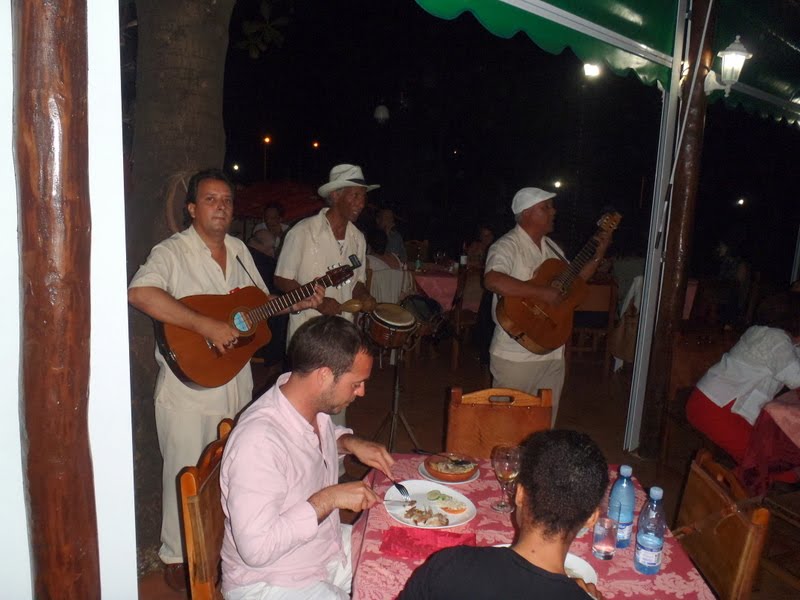
I’ll start this blog by wrapping up day #2 (our day in Havana). Just before 8PM, we boarded our bus and headed to the Hotel Nacional for dinner. We enjoyed another very tasty traditional Cuban meal (two kinds of rice, freshly fried potato chips, pork, chicken, and a unique passionfruit sauce for dessert) while being serenaded by a band:

After dinner, we were all encouraged to take advantage of Havana’s famous nightlife. The students were led by our guide Ludwig to a jazz club. We separated at that point, but I’m sure that everyone had a fun and safe time.

Day #3 began with breakfast at the hotel. We boarded the bus at 9AM. After a brief stop to stock up on bottled water ($0.65 per bottle) and exchange currency ($1 = $0.87 CUCs, the official Cuban currency; exchange requires a passport). We then headed out on a three-hour drive to the Zapata Penninsula, home to large stretches of nature preserves (roughly equivalent to the Florida Everglades).

We entered the Zapata National Park, the largest wetland in the Caribbean and Cuba’s largest park. We will be visited various locations in this Park for the next few days. Our first stop was a botanical garden featuring some of the native hardwood tree species of Cuba (and, it was noticed, lots of mosquitoes):

We also spotted emerald hummingbirds (one of three Cuban endemic hummingbird species). From there, we drove on to the Treasure Lake preserve, so named because native Cubans used to hide their gold there to prevent Spaniards from finding it. The preserve contains a network of mangrove swamps criss-crossed with natural waterways. We piled into two speedboats for a 20 minute journey across the Tesoro Lagoon to a series of lodges on an island:

There we had lunch—admittedly the worst food we’ve had in Cuba so far, but not bad given the difficulty in getting any provisions to this remote spot. And the view (from a large thatched lodge on stilts over the water) was fantastic:

We toured the island, which featured eco-tourism huts (where people can stay—bring a book!), a long boardwalk path, many horizontal-leaning palm trees, various bird species (including several varieties of ducks), several species of gecko lizards, a variety of sculptures depicting life for Cuba’s indigenous peoples, and mock-ups of a Taina village showing their dwellings complete with locals dressed in period costumes:

Given the hot, humid, sweltering day, we stopped several times for drinks. After a very fast speed boat ride through the swamp (which was a blast!), we visited a crocodile refuge and breeding center. There we saw Cuba’s largest native rodent, the jutia and crocodiles of various sizes and ages. We watched the adult crocodiles feed on crabs. The students were all able to hold a juvenile crocodile (after it had been secured by a guide), which was a real thrill for all:

After a 20 minutes bus ride, we arrived at the town of palpate to visit Korimakao, a state-sponsored artists’ colony. Here, teenagers with artistic talent are paid to hone their craft and develop into professional painters, singers, and dancers. We toured the grounds, visited the galleries, and watched a performance by the dance troupe:

By this point, it was late afternoon. We were all pretty hot and sticky from the heat and humidity of the day. We were glad to arrive at our new hotel, the Playa Larga Hotel. The students were all quite psyched to see the pool and the ocean. This hotel looks like a retirement community, with individual candy-colored buildings, each one story with a patch of lawn and rocking chairs out front. Pairs of students were assigned to a bungalow, each of which contains a sitting room, bathroom, and 1 or 2 bedrooms with air conditioning. Everyone was quite impressed with the quality of the accommodations. We enjoyed a dip in the ocean to cool off, and then a group dinner that featured local crab:

Unlike our hotel in Havana, this one is quite isolated, with no other place to visit in the neighborhood. I was disappointed to discover that, although they have Internet at this hotel, it is currently not functioning. I am writing this paragraph at 9PM on 5/16, but it may be days before I am able to post it. We shall see!

Everyone is well, with no significant problems. We look forward to a most interesting day tomorrow visiting the Bay of Pigs.

Best wishes from Cuba,

ejs